Caima is a centennial company that celebrates its 130th anniversary in 2018.
It originated from the company "The Caima Timber Estate and Wood Pulp Company Ltd.," founded in May 1888 with the aim of producing pulp for paper.
Throughout these years, Caima has had paper manufacturers from all corners of the globe among its clients. In 2012, Caima decided to venture into a new market by producing dissolving pulp for textile fibers and other specialty chemicals.
Caima is the only company in Portugal and one of the few in Europe that produces dissolving pulp using the magnesium bisulfite process.
Currently, Caima has the capacity to produce approximately 125,000 tons of pulp per year.
Caima is also involved in the renewable energy sector, producing over 130 GWh of electrical energy per year from forest biomass.


1. WOOD
Reception and inspection of the raw material. The eucalyptus wood comes from planted forests managed according to strict criteria of sustainability and environmental responsibility.

2. DEBARKING AND CHIPPING
Reception and inspection of the raw material. The eucalyptus wood comes from planted forests managed according to strict criteria of sustainability and environmental responsibility.
3. WOOD COOKING
In this section, the wood is subjected to a thermochemical process with magnesium bisulfite acid, which separates its constituents.
4. PULP WASHING
Using only water and no other chemicals, the pulp is washed to remove the by-products of cooking, leaving behind only the cellulose fibers.
5. CHEMICAL RECOVERY
The resulting liquor from the process is burned in a boiler, producing high-pressure steam that is fed to the factory's turbines, generating electricity.
6 . PULP BLEACHING
Performed in three stages, this process determines the most important final characteristics of the pulp, differentiating it based on its intended application.

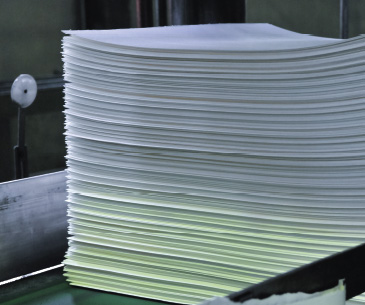
7 - DRYING AND FINISHING
Here, the fibers form a "web" consisting of 99% water and 1% fiber. Upon exiting the former, the sheet contains around 60% water and 40% fibers.
8. PULP BALES
The pulp is packaged, marked, and ready to be shipped in 200kg bales grouped in sets of 8, stored until they are dispatched to customers.